The record at a glance
- Catalogue category
- General
- Developer named by source
- Come App Team
- Source-listed version
- 1.0
- Source-listed size
- 19.74 MB
- Artifact relation
- Standard/Sports container
The catalogue record and its attribution
The dated catalogue attributes Come.com Download App to Come App Team and displays 1.0 at 19.74 MB. These are source fields, not a company identity authenticated by D1. The listing is one editorial entry in a larger collection; it does not establish a separately implemented Android product for every title.
Compare a release row before comparing files
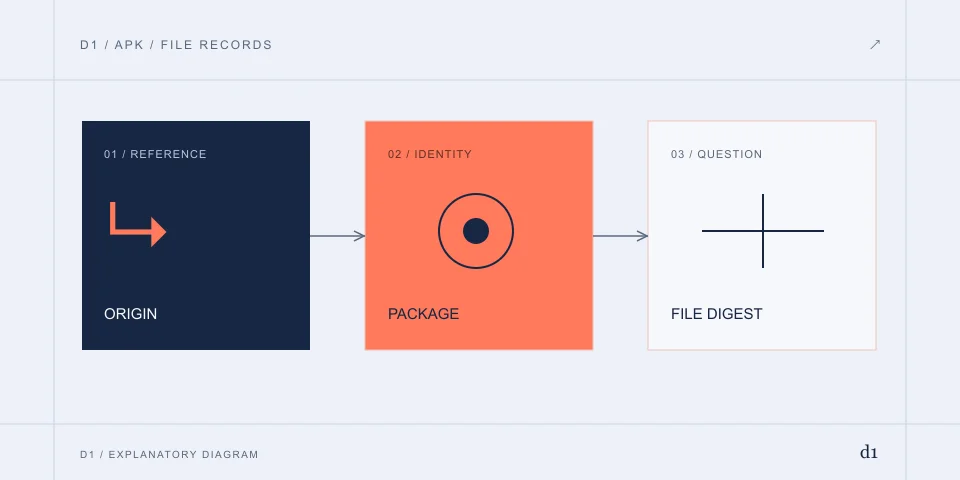
This record is about APK distribution and release references. A useful file comparison names the intended manifest row, package, version code, byte count and digest. “Come.com download” alone can refer to a page, a browser shortcut or a different binary.
Two filenames, one release
The retained Standard reference is a useful naming trap: a current-looking and an archived-looking filename were associated with the same bytes. A filename can change while the object does not. Conversely, identical filenames on two origins can contain different objects. For a Come com lookup, the important question is which source and release row the sender intended. The domain-like wording is a query label here, not proof that the similarly spelled domain distributes this package.
Build a release chain from the original page
Save the source page URL, the exact platform row and its stated release fields. Then keep the obtained filename, byte count and measured digest in another column. If a forwarded mirror is involved, record that origin too rather than replacing the original source. This allows a later reader to see whether the file was renamed, redirected or genuinely changed.
Two names can lead to one retained object
The historical Standard downloads provide a concrete example: the current-looking and archived-looking names yielded the same retained bytes. Calling the latter an old version would manufacture a release distinction. A useful catalogue can show both paths and one artifact identity. To investigate an actual update, find a changed version code, signer relationship or content digest within that same package.
Which Android artifact is being compared?
The following fields identify the historical artifact associated with this catalogue record. They were retained in the 30–31 October 2026 source archive, not measured again by D1 for this article. The case above concerns two filenames, one release, so file identity and the claimed user outcome must be assessed separately.
| Field | Value |
|---|---|
| Package | com.come.sports |
| Version | 1.0 / code 1 |
| Byte count | 20,696,772 bytes |
| SHA-256 | 6bf5b47239c4407dfb97d7c49b5639ab1f7b335fb5fff05e0360aa1f11338ccd |
| Observation | Reference archive, 30–31 October 2026 |
What the device record can settle
The Android reference connected with Come.com Download App uses SDK 24 as its minimum, or Android 7.0, and target SDK 36. Its signing reference reads Android Debug; debuggable=true. These are manifest and certificate observations. They do not demonstrate installer acceptance, first launch or privacy behaviour on a device. A PC shortcut or iPhone PWA needs a separate attributable object.
For the shared acquisition procedure, use the Come APK transfer and installation checks
Where the provider takes over
If Come.com Download App leads to another origin, record that origin before entering account details. A wrapper can launch a page without owning its login. A saved draft or local note also cannot establish an accepted contest entry. Registration, authentication and a financial review remain distinct events.
If the account provider is unclear, first separate the Come APK product identities
Read the failed assumption before repeating the action
| Observation | What it establishes | Remaining question |
|---|---|---|
| Different names, equal digest and bytes | Same retained object under two labels | Is there any separate release evidence? |
| Same name, different digest | Different bytes | Which source, date and package explain them? |
| A page named Come.com | A navigation reference | Does it provide the intended platform row? |
Choose by task rather than a similar name
The neighbouring record below examines a related task from another angle. Use it to compare the workflow described for Come.com Download App, rather than treating two catalogue names as two authenticated native applications.
A collection needs reproducible release references
For shared release evidence, start with the COME APK platform and artifact map
To choose among neighbouring explanations, open the COME APK provenance comparison
A Come com link can lead to a page, a file or a login
Consider three links in a chat: one opens release notes, one transfers an APK and one opens an account form. Even if all three messages say Come com download, only the second action establishes a file transfer. The release notes may identify the intended file; the form belongs to a receiving provider. Treating all three as an installed update makes a later complaint impossible to localise.
In the retained Standard example, two filenames refer to the same bytes. That is a concrete reason to preserve source and object separately. An unavailable release page leaves current distribution unresolved; it does not make the next similarly named result an authenticated substitute. D1 does not declare ownership of a Come.com domain from this catalogue label.
| Observed response | Useful record | What remains unproved |
|---|---|---|
| Release page | Origin, platform row and observation date | That a file was acquired |
| APK transfer | Completed object, package, bytes and digest | Publisher ownership or successful execution |
| Provider login | Receiving origin and original profile | Shared credentials or migrated funds |
For an incomplete forwarded reference, use Come APK link recovery steps
For the platform and package comparison, read Come APK
When Come com is combined with Dream11
The added Dream11 word changes the identification question; it does not complete the affiliation evidence. Sporta’s Dream11 Android package is com.dream11.fantasy.cricket.football.kabaddi. The retained Standard container is com.come.sports. Dream11App Full and Lite use com.dream11app.dev and com.dream11app.lite. A common search phrase cannot replace those different identities.
A person with a Sporta OTP issue should reach the login procedure directly. A person comparing an independent Dream11App release should reach its Full/Lite record. The combined-name case explains this split without calling either route an account migration.
For the planning-versus-account example, read Come com Dream11 relationship case
For the original Sporta profile, use Dream11 login
For the independent release record, compare Dream11App Full and Lite 3.12.1
For the summary comparison, return to Come com and Dream11 product chooser
Q / A
Common questions
Two filenames, one release — what remains to check?
A page named Come.com: A navigation reference. Does it provide the intended platform row?
READ THE SOURCE / CHECK THE DATE
Documents & references
Dates below belong to the historical references. The writing date does not represent a new account or file test.
- ComeAPK — Come.com Download App source record2026-10-30 · comeapk.dev
- ComeAPK — platform manifest2026-10-30 · comeapk.dev
D1 is an independent information publisher. Product providers handle their own accounts, files and transactions. How we write →